
The Chip Only Three Companies Can Build
Every phone, car, and AI model on earth runs on a technology that only three companies can manufacture — and only one company can build the machines that make it possible. Here’s how that happened, and why it matters more than ever.
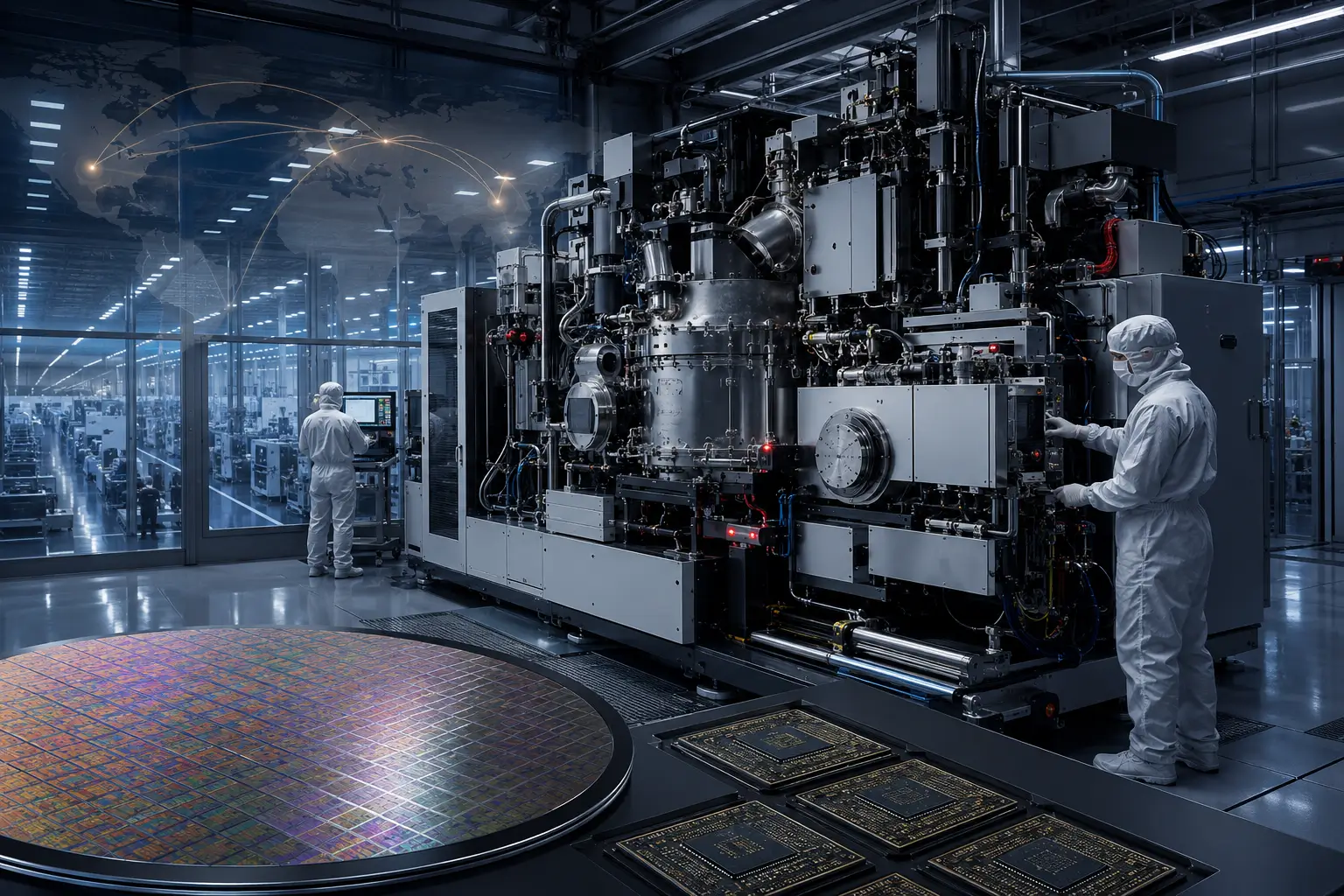
Somewhere in the Netherlands, a machine the size of a city bus fires molten tin with a laser fifty thousand times a second, producing light hotter than the surface of the sun. Only one company on earth knows how to build that machine. Without it, the modern economy grinds to a stop.
Every smartphone, AI server, electric vehicle, and modern weapons system depends on advanced semiconductors — logic chips manufactured at the very edge of what physics currently allows. Making them is one of the hardest industrial feats humans have ever attempted, and the difficulty has produced an extraordinary bottleneck: almost the entire world’s supply of leading-edge chips passes through one company, on one island, using machines built by one other company.
This isn’t a temporary shortage. It’s the endpoint of seventy years of exponentially rising costs, and it has quietly become one of the most consequential points of economic and geopolitical leverage on earth.
01 — ConcentrationOne Island, One Company, Nine in Ten Chips
Ask which companies can actually manufacture a modern leading-edge chip — the kind inside an iPhone, an Nvidia GPU, or a fighter jet’s radar system — and the honest answer is: almost none of them. Taiwan Semiconductor Manufacturing Company, known as TSMC, now produces roughly 90% of the world’s chips built at 5 nanometers or smaller. Samsung, in South Korea, holds most of what’s left. Intel, once the industry’s defining name, barely registers at the leading edge, having spent much of the last decade falling behind its own manufacturing roadmap — a slide serious enough that the US government took a 10% equity stake in the company in 2025.
This wasn’t inevitable. TSMC’s founder, Morris Chang, built the company in 1987 on a single, radical promise: it would manufacture chips for other companies and never compete with them by designing its own. That guarantee is what allowed an entire generation of “fabless” companies — Nvidia, Qualcomm, Apple — to exist at all. They design; TSMC builds. Three decades later, that arrangement has hardened into the closest thing the global economy has to a single point of failure.

02 — The EconomicsWhy Nobody Else Can Compete
The reason so few companies can do this isn’t a lack of ambition. It’s arithmetic. Semiconductor engineers have long lived by two laws. The first, Moore’s Law, says the number of transistors on a chip roughly doubles every two years. The second, less famous but arguably more important, is Rock’s Law: the cost of building a factory capable of keeping pace roughly doubles every four years. In the early 1970s, a fab cost a few million dollars. Today, a single leading-edge facility costs upward of $28 billion — a nearly thousandfold increase, even after adjusting for inflation.

That cost has to be earned back through relentless, full-capacity production. That’s exactly why the industry consolidated around a handful of giant foundries rather than staying fragmented the way it was in the 1980s, when dozens of companies could still afford to build their own fabs. Design costs have climbed just as fast: engineering a single chip at the 2-nanometer node can now cost roughly $2 billion, before a single wafer is even fabricated. Only a handful of companies on earth sell enough chips to make that bet pay off.
03 — The Chokepoint Behind the ChokepointThe Machine That Makes the Machines
Even TSMC and Samsung don’t operate alone. To print circuits fine enough for a modern chip, foundries rely on extreme ultraviolet, or EUV, lithography — a technology so difficult to build that, after a roughly 30-year, multibillion-dollar race, exactly one company on earth ever cracked it: ASML, a Dutch firm few outside the industry have heard of. The bet started as a government-funded long shot. Intel put $200 million behind it in 1992, when most of the industry doubted it would ever work, and it took until 2019 — nearly three decades and a dedicated US national-lab research consortium later — before a single commercial chip was actually printed with it. That’s according to a detailed history of the technology published by Georgetown University’s Center for Security and Emerging Technology. Each finished EUV machine now costs upward of $400 million, takes months to install, and is built from more than 100,000 components sourced from thousands of suppliers worldwide. TSMC, Samsung, and Intel all depend on ASML completely. There is, at present, no alternative supplier — and no serious one on the horizon.
China isn’t allowed to buy that machine at all. The Netherlands banned EUV exports there in 2019. But it has found a workaround one rung down the technology ladder. Older deep ultraviolet, or DUV, tools aren’t export-controlled, and by running a wafer through one of them three or four times instead of once — a costly, defect-prone process called multi-patterning — Chinese foundries can coax near-frontier chips out of yesterday’s machines. It’s inefficient: researchers at the American Enterprise Institute estimate that SMIC’s resulting 5-nanometer process runs 40–50% more expensive than TSMC’s, with yields as low as 20%. But scale changes the arithmetic. Chinese buyers accounted for 70% of ASML’s DUV tool sales in 2024, worth nearly $12 billion — enough, by the same estimate, to support Huawei’s target of 1.6 million AI-chip logic dies in 2026, even as China’s overall share of world chip-making capacity stays stuck at 1–2%.
04 — Why NowAI Broke the Supply Chain a Second Time
For most of the last decade, this concentration was an industry curiosity more than an urgent problem. Then generative AI arrived, and demand for the most advanced chips, and, just as importantly, for the advanced packaging that turns raw chips into finished AI accelerators, exploded far faster than anyone could build capacity to match. Nvidia alone has locked in roughly 60% of TSMC’s entire advanced-packaging output for 2026, leaving every other AI chip designer on earth, including Google, Amazon, and Meta, to fight over what remains. TSMC’s own executives have described that capacity as sold out more than a year in advance.
The company is racing to respond, nearly quadrupling its advanced-packaging output in under two years. It still isn’t enough. That single fact — that the world’s most valuable industry cannot expand fast enough to meet its own demand — is now one of the defining constraints on how quickly artificial intelligence can actually be built.
05 — The Fault LineA Company, an Island, and a Fault Line
All of this would be a remarkable business story on its own. It becomes a geopolitical one because of where the concentration sits. TSMC’s most advanced production is overwhelmingly based in Taiwan, a self-governing island that China claims as its own territory. Some analysts call this Taiwan’s “silicon shield” — the theory that the rest of the world has too much riding on Taiwan’s chip industry to allow a serious conflict there. Others argue the opposite: that a blockade wouldn’t need to touch a single fab to be devastating, since simply disrupting shipping lanes would freeze global chip supply just as effectively.
China, for its part, isn’t waiting to find out. Its DUV workaround, described above, is only one piece of a broader effort: the number of Chinese firms added to the US Commerce Department’s export blacklist jumped from 141 in 2018–19 to 425 by 2021–22. Yet Huawei still managed to release a smartphone in 2023 built around a 7-nanometer chip that, on paper, sanctions weren’t supposed to allow. The phone sold more than 30 million units. Chinese chipmakers remain years and multiple technological generations behind the frontier. But the direction of travel is unmistakable: two increasingly separate chip ecosystems, built on incompatible foundations, both racing toward the same finish line.
The TakeawayOne Company Away From a Problem
The modern economy runs on a technology so difficult to manufacture that, at the frontier, it has collapsed into a handful of companies — really, in the most advanced case, one machine-maker and one chip-maker the entire world depends on. That concentration isn’t a market failure so much as the predictable result of costs that have doubled every few years for half a century. What’s changed is the stakes: artificial intelligence has turned a slow-moving industrial curiosity into one of the tightest, most consequential bottlenecks in the global economy, and turned a small island in the Pacific into one of the most important pieces of infrastructure on earth.
The lesson extends beyond chips. When an entire global industry depends on a handful of irreplaceable nodes — a single machine-maker, a single island, a single packaging line — the risk isn’t just business risk. It’s systemic risk, and it rarely shows up on a balance sheet until it’s too late.
Read the Full Research Note
Explore the complete case, additional evidence, charts and detailed sourcing behind the semiconductor manufacturing chokepoint.
Full Research NoteIssue 06 of an ongoing series delivering business, economic, and commodity insight — from the team behind the Trimline Group.
References
- BCG. (2023). Navigating the costly economics of chip making. Boston Consulting Group.
- CNBC. (2026, April 8). Nvidia snaps up AI chip packaging capacity as TSMC expands in U.S.
- CNBC. (2022, March 23). Inside ASML, the company advanced chipmakers use for EUV lithography.
- Construction Physics (Potter, B.). (2025, February 6). How to build a $20 billion semiconductor fab.
- Construction Physics (Potter, B.). (2024, December 31). Morris Chang and the origins of TSMC.
- Fedasiuk, R., & Torres, J. (2026, April). The lithography loophole: How China is printing its way to chip self-sufficiency. American Enterprise Institute.
- Flamm, K. (2018). Measuring Moore’s law: Evidence from price, cost, and quality indexes (NBER Working Paper No. 24553). National Bureau of Economic Research.
- IEEE Spectrum. (2021, June 24). Morris Chang: Foundry father.
- ITIF. (2021, February 18). Moore’s law under attack: The impact of China’s policies on global semiconductor innovation. Information Technology and Innovation Foundation.
- MIT Technology Review. (2020, April 2). The high cost of upholding Moore’s law.
- Motley Fool. (2026, August). Ranked: Global semiconductor manufacturers by revenue.
- SemiAnalysis. (2026, February 4). Huawei Ascend production ramp.
- Shrivastava, M., & Jash, A. (2025). China’s semiconductor conundrum: Understanding US export controls and their efficacy. Cogent Social Sciences, 11(1), 2528450.
- TrendForce. (2026, April 30). AI competition turns into a supply chain arms race, tightening advanced packaging and 3nm capacity.
- VerWey, J. (2024, July). Tracing the emergence of extreme ultraviolet lithography: Lessons for identifying, protecting, and promoting the next emerging technology (Policy Brief). Center for Security and Emerging Technology, Georgetown University.